
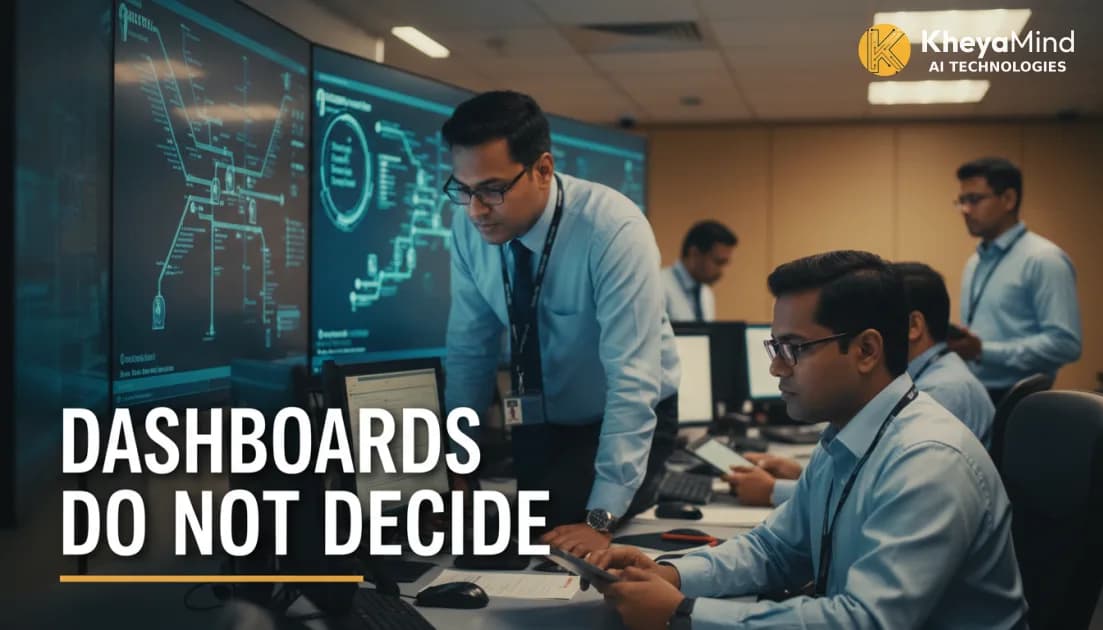
How Enterprises Can Implement Agentic Control Towers
The control tower is not the hard part. The July 22, 2026 discussion around how enterprises can implement agentic control towers is timely because most operations teams already have dashboards, alerts, and data feeds, yet exceptions still wait for people to reconcile systems, decide priorities, and chase approvals.
An agentic control tower should not become another screen competing for attention. It should become a governed operating layer that can interpret events, recommend a next action, coordinate the right people and systems, and act only within clear business limits. Visibility without decision rights is only a better view of the backlog.
Quick Answer: Enterprises should implement an agentic control tower by starting with one high-value exception workflow, connecting trusted operational events, and defining exactly what an AI agent may recommend, route, or execute. The system needs policy rules, human approval thresholds, audit trails, and measurable operating outcomes before it expands across functions.
The real gap in logistics and other operational environments sits between detection and execution. A transport management system can flag a delayed shipment. A warehouse platform can show a stock imbalance. An ERP can expose an overdue purchase order. None of those tools, by themselves, establishes who should act, which policy applies, whether an action is permitted, or how the decision should be recorded.
Why dashboards do not solve operational exceptions
Dashboards answer, “What is happening?” Operations leaders also need answers to harder questions: “What should happen next?”, “Who owns the decision?”, “What constraints apply?”, and “What happens if nobody responds?” A dashboard can put every exception in one place, but it rarely resolves conflicting service priorities, margin limits, customer commitments, inventory rules, or safety requirements.
Consider a late inbound container affecting several customer orders. A planner may need to compare available inventory, substitute products, promised delivery dates, transfer costs, customer service tiers, and supplier updates. The difficult work is not finding the late container. The difficult work is assembling a defensible action from fragmented facts and routing it to someone with authority.
A red alert is not an operating decision.
That is why a simple conversational interface is not the answer. An operations head does not need a chatbot that restates a delay in polished language. You need an AI operations orchestration system that can listen for business events, gather relevant evidence, test permissible actions against rules, create tasks or transactions, and preserve a trace of what it did and why.
Well-designed enterprise exception management does not remove operational judgment. It removes the repetitive coordination that prevents experienced people from applying judgment where it matters. The system should shorten the path from signal to informed action while keeping accountability visible.
Operations teams do not need more alerts. They need fewer unresolved decisions.
The difference also affects adoption. Teams will ignore an agentic AI control tower if it generates vague suggestions that require manual rework. They will use it when each recommendation includes the affected entity, the supporting events, the policy applied, available options, the consequence of delay, and the exact approver or system action required.
A short example makes this concrete. At a Mumbai third-party logistics firm running around 40 dispatch lanes, exceptions like delayed pickups and address failures were reconciled by hand across three systems, and the average time to resolve one sat near 45 minutes. After a governed agentic control tower was scoped to a single exception type, carrier delay, with clear approval limits, that resolution time fell to under 12 minutes and the backlog of open exceptions dropped by roughly 60% in the first quarter.
How Enterprises Can Implement Agentic Control Towers
How Enterprises Can Implement Agentic Control Towers starts with a narrow operating problem, not a company-wide AI announcement. Choose a workflow with recurring exceptions, identifiable decision owners, accessible source data, and an action that can be recorded in an existing business system. Shipment disruption, inventory allocation, supplier delay management, and field-service rescheduling are strong starting points because they have visible triggers and tangible decisions.
How Can Enterprises Implement Agentic Control Towers? | AIM - analyticsindiamag.com
The implementation sequence should move from observation to recommendation, then to controlled coordination, and only later to limited execution. This order gives operations teams time to validate data, challenge recommendations, tune rules, and establish confidence. It also stops an early pilot from acquiring authority before it has earned trust.
- Map one exception: Define the trigger, affected entities, current manual steps, decision owner, required approvals, and final system-of-record update.
- Create an event contract: Standardise the identifiers, timestamps, status values, source systems, and data owner for every event the workflow needs.
- Encode policies: Translate operating policies into explicit checks, thresholds, and escalation rules that people can review.
- Run in recommendation mode: Let the agent prepare evidence and proposed actions while accountable staff make the final decision.
- Add controlled execution: Permit low-risk actions only after the team confirms that recommendations, permissions, and logs work reliably.
- Review outcomes: Measure speed, policy adherence, overrides, failed actions, and unresolved exceptions before expanding scope.
Start with the exception that creates the most coordination, not the process that sounds most impressive.
We can design this as a custom enterprise platform rather than forcing operations into a generic agent framework. The platform can combine event ingestion, decision workflows, policy services, role-based approvals, predictive models, LLM-based evidence summaries, and integrations with operational systems. For environments where core transaction data lives in finance and supply applications, AI-Powered ERP Tools can provide the system integration layer that anchors actions to existing records.
The pilot should have a named business owner, a technical owner, and a control owner. The business owner defines what good execution looks like. The technical owner manages data and integrations. The control owner confirms permissions, approval rights, exception handling, and audit requirements. One person can fill more than one role in a smaller programme, but the responsibilities should remain explicit.
Agentic systems fail fastest when everyone assumes someone else owns the rulebook.
Choose the decisions an agent can recommend, route, or execute
Decision rights should drive the architecture. Do not begin by asking which tasks AI can automate. Begin by classifying the operational decisions that occur after an exception arrives, then determine the risk of each decision if data is stale, policy is misread, or a recommendation is wrong.
Most workflows contain three practical levels. At the first level, the agent recommends. It can assemble facts, rank options, draft an action plan, and identify conflicts. At the second level, it routes. It can assign work, request approval, notify affected teams, and create a structured exception record. At the third level, it executes a bounded action, such as updating an internal task status, requesting a permitted inventory transfer, or sending an approved carrier instruction.
Autonomy should increase only when the cost of being wrong stays contained.
Low-risk actions often include data collection, duplicate-alert suppression, evidence gathering, status updates, and task assignment. Medium-risk actions may include preparing a replenishment proposal, reserving a substitute resource within a preset policy, or issuing an internal escalation. High-risk actions include changing customer commitments, approving nonstandard spend, overriding allocation rules, diverting regulated goods, or altering a safety-critical plan. High-risk actions should require a human decision with the evidence attached.
Set these permissions in policy, not in prompts. A language model can help interpret unstructured messages, explain a recommendation, or extract constraints from documents. It should not become the sole source of authority for a financial threshold or a dispatch restriction. Put deterministic checks around the agent so policies remain testable and changes remain reviewable.
how to companies use ai
Companies use AI effectively in operations when they assign it a bounded role inside a real workflow. The best use is rarely “ask AI anything.” It is “when event X occurs, collect signals A through F, check policies G through J, present options, obtain approval if needed, and write the final action to system K.”
Good agent design turns discretion into a controlled workflow.
Illustrative scenario (not a client case study): A 180-vehicle regional cold-chain logistics operator in Singapore could receive temperature alerts, port delay notices, and delivery changes through separate systems. A governed agentic control tower could correlate those signals against vehicle capacity, delivery windows, product handling rules, and customer priority. It might rank affected loads by risk, prepare approved rerouting options, and present high-impact recommendations to a dispatcher for confirmation. The dispatcher would retain control over decisions that affect service commitments, specialised handling, or cost limits.
Build a shared event and data layer before adding agents
An agent cannot coordinate a workflow when every system describes the same shipment, order, location, product, or customer differently. The shared event and data layer does not require replacing every legacy platform. It requires a dependable way to connect their events to common business entities and preserve where each event came from.
For a logistics workflow, that layer may connect ERP orders, warehouse inventory, transport milestones, telematics alerts, supplier updates, customer service cases, and workforce schedules. Each event should carry a clear entity identifier, event time, ingestion time, source, status, confidence where relevant, and accountable data owner. When an agent encounters conflicting information, it should know which source is authoritative for the decision at hand.
If an agent cannot identify the order, it cannot own the exception.
Data quality is an operating concern, not an IT clean-up project that must finish before progress begins. Start by documenting the fields required for one workflow, assess their availability, and create a visible exception path for missing or conflicting information. If a delivery address is incomplete or a supplier date conflicts with a transport update, the system should flag uncertainty and route the case rather than inventing certainty.
Standard naming also improves observability. OpenTelemetry describes semantic conventions as common names and attributes that help standardise telemetry across codebases, libraries, and platforms. The same principle applies to operational events: agreed meanings make it easier to correlate signals and trace an action through multiple services. OpenTelemetry Semantic Conventions provide a useful technical reference for teams designing traceable service and event instrumentation.
Shared data meaning is the foundation of shared operational action.
Cloud architecture matters here because an agentic control tower needs reliable ingestion, workflow execution, access control, monitoring, and recovery behaviour. We can create the data pipelines, event services, integration APIs, and MLOps controls required for this operating layer through Cloud & DevOps AI. The goal is not to centralise every byte of enterprise data. The goal is to make the specific facts needed for a decision available, current, attributable, and secure.
Design guardrails that operations leaders can trust
Trust comes from predictable boundaries. Operations leaders should be able to see what the agent is allowed to do, when it must request approval, what sources it used, which policy it applied, and what happened after an action. If those elements remain hidden, the control tower becomes difficult to defend during a service failure, audit, or post-incident review.
A workable guardrail design includes role permissions, action thresholds, policy checks, segregation of duties, escalation timers, immutable activity logs, and safe fallback states. Role permissions determine who can view, approve, or execute each action. Thresholds establish the maximum financial, service, or operational impact that can proceed without extra approval. Safe fallbacks ensure that missing data, conflicting data, system outages, or low-confidence interpretations stop automation and create a review task.
A guardrail is useful only when it changes what the system is allowed to do.
NIST’s AI Risk Management Framework organises AI risk activities around four functions: Govern, Map, Measure, and Manage. For an agentic control tower, that translates into clear ownership and policy, documented workflow context, ongoing testing and monitoring, and active response when risks or failures appear. The framework is voluntary guidance, but its structure gives operations and technology leaders a practical common language for oversight. NIST AI RMF Core describes these functions and positions governance as a cross-cutting activity.
Build the audit record at the same time as the action path. For every material exception, retain the incoming event, data used, policy version, recommendation, approver, final action, downstream system response, and any override reason. That record supports operational learning as much as compliance. It reveals whether the problem came from poor data, unclear policy, an unsuitable model output, a bottlenecked approval, or an integration failure.
Without a decision trail, automation becomes a story nobody can verify.
Use generative AI carefully inside those controls. Natural-language systems can turn unstructured carrier updates, supplier emails, incident notes, and customer messages into useful evidence. They can also explain why an exception received a given priority. We can build domain-specific retrieval and reasoning components through NLP & Custom GPT Solutions, while keeping final decision rights and deterministic policies outside the model.
Measure whether the control tower is improving execution
Measure execution, not activity. A control tower with more alerts, more generated summaries, and more logged agent actions may look busy while making the operation slower. The scorecard should show whether the workflow reaches a correct, policy-compliant outcome with less manual coordination and better awareness of service risk.
Start with a baseline before the pilot. Measure median and high-percentile exception resolution time, the number of handoffs per exception, the share of cases escalated, policy override frequency, time spent gathering evidence, and the proportion of exceptions that lack a clear owner. Then compare the same measures after the workflow enters recommendation and controlled-execution modes.
The metric that matters is resolved risk, not AI activity.
- Resolution time: How long does it take from trigger to recorded operational action?
- Escalation quality: Does the system route the right cases to the right accountable person?
- Policy adherence: Do actions comply with allocation, safety, service, and financial rules?
- Recommendation acceptance: How often do users accept, modify, or reject proposed actions, and why?
- Service-risk visibility: Can leaders see affected orders, customers, capacity, and deadlines before disruption spreads?
- Data-confidence exceptions: How often does the workflow stop correctly because required evidence is incomplete?
Do not treat a high acceptance rate as automatic proof of quality. A team may accept suggestions because the interface makes rejection difficult, because managers require use, or because the agent handles only simple cases. Review a sample of completed exceptions against policy and business outcomes. Also investigate overrides, because repeated overrides often expose a missing rule, an outdated threshold, or a data source that lacks context.
Every override is either a learning signal or a control failure.
The measurement process should feed back into the operating design. Update policy rules when business conditions change. Retrain predictive components where drift appears. Adjust approvals when risks prove lower or higher than expected. Most importantly, keep a human review forum where operations, finance, risk, and technology leaders assess the cases that the system handled poorly or could not handle at all.
We have seen the payoff show up in the numbers. A Pune auto-components manufacturer with six plants was losing close to Rs 18 lakh a month to expedited freight triggered by late exception handling. After deploying an agentic control tower that flagged supply risk, recommended a reroute, and executed only within pre-set cost limits, expedited-freight spend dropped by about a third within 90 days, and planners moved from chasing updates to approving decisions.
Start with one exception workflow, then expand
This is the safest way for how enterprises can implement agentic control towers without betting the operation on a big-bang rollout. Expansion should follow evidence, not enthusiasm. Once one workflow has trusted event data, clear decision rights, documented guardrails, and measurable performance, reuse its patterns for adjacent exceptions. You may then add supplier delay management, inventory rebalancing, field-service scheduling, or customer commitment risk, but each new workflow still needs its own policies, data owners, and authority model.
Illustrative scenario (not a client case study): A 12-warehouse consumer electronics distributor in Kuala Lumpur could face a shortage of a high-demand item while inventory planners reconcile warehouse stock, supplier shipment updates, and retailer orders through spreadsheets and email. An agentic control tower could identify the shortage event, check allocation policies and available stock, then prepare transfer or replenishment recommendations for the accountable planner. It might route exceptions involving restricted customers, unusual transfer costs, or uncertain supplier dates for approval rather than acting automatically. The planner would receive a structured decision package instead of a scattered collection of messages and files.
Scale the operating model, not just the software.
The right first product is a governed exception-management platform with event integration, workflow orchestration, policy enforcement, AI-assisted evidence analysis, approvals, and decision tracing. It is not a generic dashboard, and it is not an open-ended autonomous agent. When designed around real operational decisions, it gives your team a practical way to move from alert monitoring to controlled execution.
How Enterprises Can Implement Agentic Control Towers comes down to a disciplined sequence: choose one exception, connect reliable events, constrain decision rights, record every material action, and prove that execution improves. Book a 30-minute control tower discovery session, and we will identify one operations workflow where governed AI agents could reduce manual exception handling within a practical pilot scope.
Written by
KheyaMind AI's editorial team publishes practical insights on AI automation, voice AI agents, and generative AI for Indian businesses. Articles are reviewed for clarity, source quality, and implementation relevance before publication.
Interested in AI Solutions?
Discover how our AI services can transform your business operations and drive growth.
Found this helpful?
Share it with your network to help others discover valuable AI insights.
FAQ
Frequently Asked Questions about How Enterprises Can Implement Agentic Control Towers
Get quick answers to common questions related to this topic
What is an agentic control tower?
An agentic control tower is a governed operations layer that combines business events, policy rules, AI recommendations, workflows, and human approvals to manage exceptions.
Where should an enterprise start with an agentic control tower?
Start with one repeatable, high-impact exception workflow such as shipment disruption, inventory allocation, supplier delay, or field-service scheduling.
Can AI agents make operational decisions automatically?
They can execute low-risk actions within preapproved limits, while higher-impact financial, customer, safety, or policy decisions should require human approval.
What data does an agentic control tower need?
It needs consistent event data from systems such as ERP, warehouse, transport, supplier, customer, and workforce platforms, with clear ownership and timestamps.
How do you govern AI agents in operations?
Use decision thresholds, role permissions, policy checks, escalation paths, audit logs, data-quality checks, and safe fallbacks for incomplete information.
How should enterprises measure control tower success?
Track exception resolution time, escalation rate, policy adherence, recommendation acceptance, service-risk visibility, and the quality of completed actions.